Saturday, April 7, 2012

Corpse Killer: Graveyard Edition - Sega Saturn

So you just bought a Sega Saturn, and you want a kick ass zombie game.  Corpse Killer?  That's GOT to be awesome!  Yeah, no.  The cover does say that it's "One of the top 20 games of the year," though.  I shudder to think what the "bad" Saturn games of 1995 were...


Corpse Killer - also released for Sega CD and Sega CD32x, 3DO Interactive Multiplayer, Windows, and Macintosh - is a rail shooter that displays the early and mid 90's obsession with Full Motion Video (FMV).  Impossible before the dawn of CD based gaming, FMV was all the crazy for the early disc based systems.  Some games went to extreme of being advertised as "interactive movies" instead of actual video games.  Now, Corpse Killer didn't go that far, but it does have a LOT of FMV clips that display acting that would make Sylverster Stalone look like a good actor.

The backstory is that a "necrobiologist" named Dr. Hellman has gone to some Caribbean island to raise an army of the undead.  You're part of a five man Navy SEAL team sent in to shut down Hellman's operation, but everyone except you gets captured.  You meet up with a hyper-stereotypical Jamaican named Winston and an American reporter named Julie, and you end up running errands for them; Winston wants to go treasure hunting so he can buy a Hummer (he obsesses over Hummers throughout the entire game), and Julie wants to get photos proving that Hellman had funding from the Pentagon.

I'll provide examples of how ridiculous the FMV acting is.  It starts with the opening scene and some screwing around on the menu (I didn't make this video), but the truly ridiculous part starts at about 1:50, and at about 2:45, you can see some actual gameplay from the first actual part of the game.


As you can see, my less-than-positive opinion of the acting quality is not hyperbole.  It's an interesting game, though, and it's worth playing through once.  It's an important part of the development of video games. I wouldn't spent too much time on this game, though; there are more fun things to do like splitting hairs or watching paint dry.

Televisions - The Crux of the Gaming Experience

Every gamer knows that the foundation if any gaming experience is the television.  For modern gamers, who wants to play a PS3 on a 30 year old TV that doesn't even support composite A/V hook ups?  For retro gamers, though, an LCD HDTV can pose even more of a problem.  Sure, playing an HD console on an SDTV via an RF Adapter would suck, but at least you can play that way.  For the pan-generational gamer like me, one TV simply isn't enough.

Who doesn't want a huge 72 inch 1080p 3D plasma screen TV?  I mean, I'd LOVE to have Pong take up six feet of my wall (I'm not even kidding, that would kick ass).  But that alone wouldn't work for me.  I'm using a 32 inch LCD HDTV, and I can't play Duck Hunt or Lethal Enforcers on it.  Why?  Those are light gun games, and light guns only work on old CRT TVs.  I'm not sure exactly why - something about the nature of a cathode ray tube - but it won't work.  Granted, I do have a 24 inch SD CRT TV beside it into which I usually keep my NES plugged, but until I buy a longer composite cable, my Genesis won't reach that far.

Gamers who don't just play new games or old games need two TVs side by side.  Normally, I like having my NES connected to my widescreen LCD TV.  If I want to play Duck Hunt, though, that HDTV is useless.  I've got to dust off the old CRT.  For an example, here is my set-up.


As you can see, I have my big HDTV in the middle of things as the centerpiece of my set up, but I also have the CRT TV right beside it so I (once I get a longer cable from my A/V hub) can play games on it, too.  This is what I suggest for all gamers who play both newer and older games if you can afford it and have room for it.

Wednesday, April 4, 2012

Do Video Games Constitute Art?

I've been fighting an uphill battle in arguments for some time now.  Are video games art?  Of course not!  They're just ways to suck parents' and kids' money, rot our children's brains, and corrupt the youth of America with sinful games like Grand Theft Auto and Leisure Suit Larry.  Right?

Well, I've argued to the contrary for years, and the Smithsonian is finally backing those who agree with me.  Video games do constitute art.  Games frequently cited to the contrary like Grand Theft Auto, Call of Duty, Gears of War, etc. are exceptions to the rule, not the rule itself.  I would argue that even those constitute art, but I'll address that later.  Let's take photography.  That's art, is it not?  Of course it is.  Almost no one would argue otherwise.  Film is the same.  Anyone who's seen The Godfather or Sparticus knows that film is an artform.  What about pornography, though?  I mean straight up hardcore porn.  Is that art?  Because art is such an ambiguous term, there will always be those who argue that it is, but most people would say no, it's not.  Porn is the exception to film and photography, not proof that those media aren't art.  Video games is just another, much newer, medium of art.

If you really look at it, video games, like film, is an artform that is actually a compilation of other artforms.


The Legend of Zelda games have, in my opinion, the most remarkable, breathtaking musical scores of any game series, and it's better than most movies.  The Song of Time alone proves that.

In the realm of visual art, Mass Effect 2's image of the Illusive Man at the Cerberus headquarters with the red giant out his window is a haunting but beautiful image.


The literary art portion of video games is simply telling a story.  The two series I've already mentioned - Mass Effect and Legend of Zelda - do this wonderfully, but for this example, I'm going to choose a game that never got the attention it deserved and tells its story in such detail that it's almost too in-depth.


Shenmue was a Dreamcast title that, at the time of development, was the most costly video game ever produced.  Its lead developer intended it to be an "interactive movie" with its depth.  You can interact with almost everything, you have to wait for time to pass as it would in a real day, and there are no in-game clues or tutorials to help you solve the mystery of your father's murder.  Shenmue took video game storytelling to a depth rarely seen before or since.  It's a shame that America never gave it the popularity this masterpiece deserved.

Video games have also incorporated a style of art rarely ever recognized - the work of the developers.  Game developers, aside from the story, graphics, and audio in a game, often do a lot of work to work around system limitations.


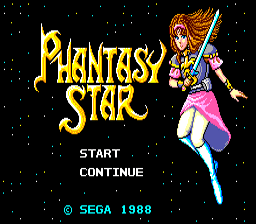
Phantasy Star for the Sega Master System is an early example of this.  The developers of Phantasy Star, by manipulating the cartridge's capacity, were able to fit significantly more data on a single cartridge than most developers knew was possible for the Master System.  Phantasy Star is the Master System game with the largest amount of data on a cartridge because of the unique solution these developers formulated.

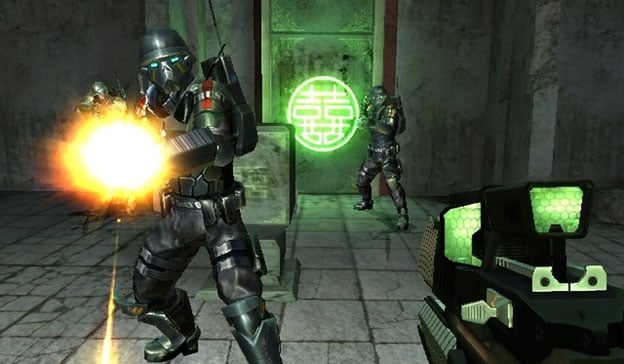
Another example of this same sort of ingenuity, this time in the realm of graphics, is Conduit 2 for the Nintendo Wii.  The Conduit, during its early alpha stages, was mistaken at E3 for an Xbox 360 game being developed.  It didn't live up to its graphical hype upon release, but Conduit 2 did.  Obviously, given the Wii's hardware, it was never truly possible for the finished product to resemble an Xbox 360 game, but the developers at High Voltage did more with the Wii's graphical hardware than most gamers thought possible, proving that even without powerful hardware and high definition graphics, some effort and creative thinking can still produce beautiful visuals.


Also sporting graphics that no one thought possible for the system was Legend of Zelda: Twilight Princess.  Although released for both Wii and Gamecube, the game - graphics included - were developed on and for the Gamecube.  The Wii version is an exact port with added motion controls.  The Gamecube, whose true capabilities were rarely used despite being the second most powerful system of its generation, went out with a bang by delivering the most beautiful graphics that the system had ever seen.  Most people don't believe me when I tell them that Twilight Princess, even the Wii version, uses Gamecube graphics.


I've made my case for video games' being art.  So what is art?  Webster defines art as "the conscious use of skill and creative imagination especially in the production of aesthetic objects."  Let's take Starcraft 2 for our example this time.  Starcraft was released in 1998; Starcraft 2 was released in 2010, and development began in 2003.  Spending seven years developing one game?  I would definitely call that "conscious use of skill and creative imagination," especially since Halo, one of the most successful FPS series, is based on Starcraft.


Art is always a subjective thing; it has no objective criteria or qualifications.  What is art to one person may be garbage to another, so the question posed by the this blog is, if we want to get technical, unanswerable.  If we want to get philosophical, anything man-made is art.  Let's keep is less complex, though; do video games meet the basic, widely accepted definitions of art?  I think I've made the case that it does.  Especially since the Smithsonian has open acknowledged it as an artform, I think that this argument will soon disappear.

Monday, April 2, 2012

First Person Shooters - The Devolution of a Genre

Right now, first person shooters are all the rage in America.  Call of Duty is the stereotype video game these days, and for good reason; the past five titles have easily surpassed 10 million units sold.  So there couldn't possibly be anything intrinsically wrong with the genre, right?  Well, that's a matter of opinion.  I'm going to pose an idea here, and you're free to take it or leave it.  I propose that the first person shooter genre is broken, and that each subsequent title that furthers this brokenness serves only to make it less likely that it will be redeemed any time soon.  Allow me to make my case before you flame me, if you please.

Bioshock.  Halo.  Halo 2.  Halo 3.  Halo Reach.  Red Steel 2.  The Conduit.  Conduit 2.  Mass Effect.  Mass Effect 2.  Mass Effect 3.  Metroid Prime.  Metroid Prime 2.  Metroid Prime 3.  Star Trek: Voyager - Elite Force.  Fallout: New Vegas.  Half-life.  Half-life 2.  Perfect Dark.  F.E.A.R.  Call of Duty.  Call of Duty 2.  Medal of Honor: Allied Assault.

I just listed 23 games.  What do they all have in common?  They're all first person shooters (we'll argue definitions in a minute) that have at least "pretty good" storylines, and those are just the games that I've ever personally played or seen enough of to get an idea.  Some, like The Conduit, are cliche, but they are executed well.  Some, like Call of Duty 1 and 2 and Medal of Honor: AA, are based on parts of history everyone knows.  What makes them eligible in my eyes to be on this list is that their campaigns are good.  The way they tell their stories is good.  When it all comes down to it, true originality doesn't really exist anymore; just about everything is a rehash of something else.  What makes a game good is if they do that rehash well.

Now, let's briefly talk definitions.  What does "FPS" mean?  First person shooter.  I will admit, Mass Effect is not a traditional FPS; it's an RPG.  Metroid Prime is not a traditional FPS; it's an adventure game.  However, in both series, the perspective is first person (at least in combat, Mass Effect is, and Fallout has an optional first person perspective), and you shoot things.  Ergo, first person shooter.  Both series are, at least in my opinion, FPS by virtue of a "secondary" genre.  Think "unofficial" tertiary types in Pokemon, if you will; Charizard and Gyarados as "unofficial" Dragon-types, or Blaziken as an "unofficial" Flying-type.

Now that I've pre-emptively defended myself against the flames that I knew would come from including Metroid Prime and Mass Effect, let's go back to what I mean when I say that the genre is broken.  Look at the single players for every Call of Duty game from Modern Warfare on.  They're terrible.  The storylines are horribly written, the dialogue is terrible, and it just feels like Activision didn't put any effort into it.  To a small extent, Black Ops got away from this with the way they structured their campaign, but the actual missions still felt just as lifeless.  Battlefield isn't much better.

People tell me all the time, "Call of Duty is about the multiplayer, not the single player."  That's all fine and well, but if that were the case, do what Valve did with Counter-Strike: Source; make it exclusively multi-player.  I, personally, think that the single player should be the crux of the game with any multiplayer, local or online, as a bonus, but I won't nitpick that much here.  Valve set out to make an amazing multiplayer game, and that's what they did.  They didn't insult us by throwing some crap together at the last minute and calling it a campaign.

Now this doesn't mean that you can't enjoy these "subpar" FPS games.  I absolutely ADORE Unreal Tournament, but its single player is even more insulting than the recent Call of Duty games'.  My point is not to bash people who play Call of Duty.  I myself am guilty of putting Modern Warfare or World at War into my Wii from time to time.  The point I'm trying to make is that these games are stifling what past precedent has proven can be a WONDERFUL genre.  First person shooters don't have to be all online play devoid of any respectable storyline, but so often they are.  I love that Ubisoft made Red Steel 2 the way they did.  There's not multiplayer, local or online, but the single player is SO fully and completely satisfying that it doesn't need it.  Now, I'm not saying that a truly good game shouldn't have multiplayer.  On the contrary, I think most games should.  What I like is that Red Steel 2 didn't need multiplayer, and whether it was intentional or accidental, Ubisoft proved that point.

Retro RPGs - The Lost Great Art

Being on the verge of finally completing Final Fantasy for NES, in the midst of Final Fantasy VII for Playstation, and having just finished Mass Effect 3 for PC, I've been thinking recently about how RPGs have developed over time.  Having played RPGs from pretty much every gaming generation, I can safely and adamantly claim that (in my opinion) old RPGs are by far the best.  Don't get me wrong, I LOVE the exploration involved in Fallout: New Vegas and Mass Effect 2 (yeah, Mass Effect 3, too, but it wasn't nearly as good), but older RPGs are just more...I don't know.  They just feel better to me.  Those in the middle - 5th and 6th generation RPGs - are sort of in that middle area.  Don't get me wrong, I love them and all (who WOULDN'T love Final Fantasy VII?), but they don't quite have that special "something" that old RPGs have and haven't quite developed the epic depth of new RPGs.


I insist that this is one of the greatest RPGs of all time.  It made my Master System great in a way that I never expected.  What makes Phantasy Star stand out from the other greats of the 3rd generation like Final Fantasy and Dragon Warrior was the way they did dungeons.


Each dungeon in Phantasy Star was a first person labyrinth like that.  For an 8-bit cartridge that could only hold about half of one megabyte, it's incredible, and it gave the dungeons a depth that you really didn't see until the 3D polygon graphic style of the Nintendo 64 and Playstation.  This game, more so than any other that I've ever played, truly showed off how much stronger the Master System's hardware was than that of the NES.  Let's not forget about the giant of that generation that kicked off a series that is still alive and well over a quarter century later.


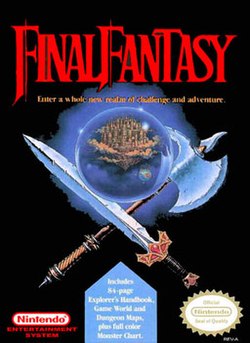
Final Fantasy - the quintessential fantasy RPG series.  It has seen no rival in popularity, and for good reason.  This game threw you into a world about which you knew almost nothing and gave you nothing.  You had to search and work for every clue as to what to do next and where to go.  I'll admit it up front; I couldn't do it without a strategy guide.  At the time that I'm writing this, I'm still stuck on the last dungeon.  Square really got it right with this game.  There are a lot of bugs in it that showed how desperate the company was at the time, but when push came to shove for Square financially, they shoved back with a force not seen again until the Wii turned around Nintendo's bad luck streak with consoles.

But let's get back to the real topic of this - retro RPGs as a lost art.  I can't put my finger on what it is that made them so much better to me.  Maybe it's because they were so much more brutally difficult than most RPGs today.  They had to be; with such limited cartridge capacity, the only way to make a game last long enough to be worth the $50 you paid for it was to make it brutally difficult, hence the slang difficulty description "Nintendo hard."  But is that really it?  Perhaps is that they left so much up to the imagination.  They only had 8-bit graphics, so you really had to imagine the details of each character and enemy.  What voice capabilities were there were extremely limited and poor quality, so you had to imagine what dialogue would sound like.  Perhaps it's that, because of that limited cartridge size, developers didn't flesh out a story as much as modern games do, again leaving it up to the imagination.  Or maybe I'm just being nostalgic.

Don't get me wrong; modern RPGs deliver a story in a way more beautifully crafted and executed than most movies can.  They give you a way to be whoever you want whenever you want in beautiful HD detail.  I'm sure that there is no small group who would disagree with just about everything I've said, but I really do feel that retro RPGs had a certain magic that newer games have lost.